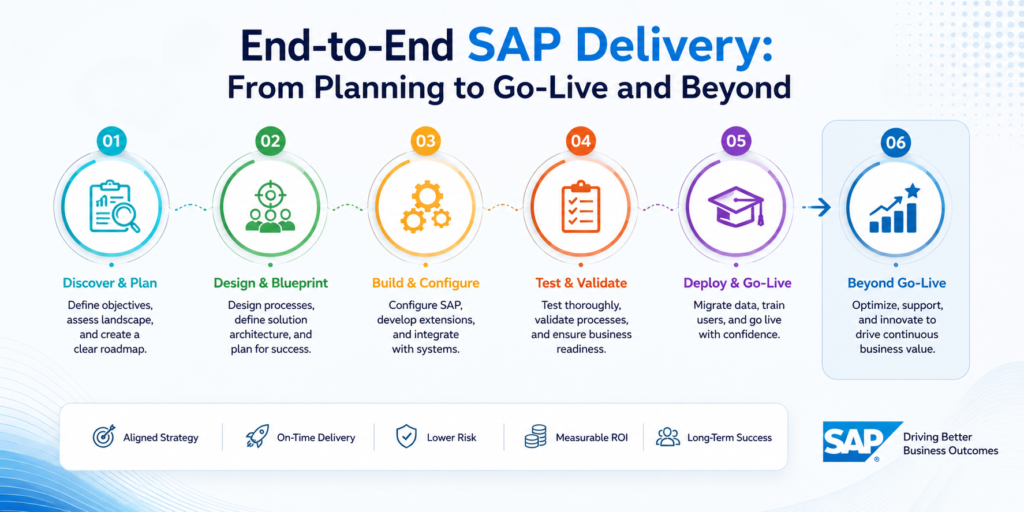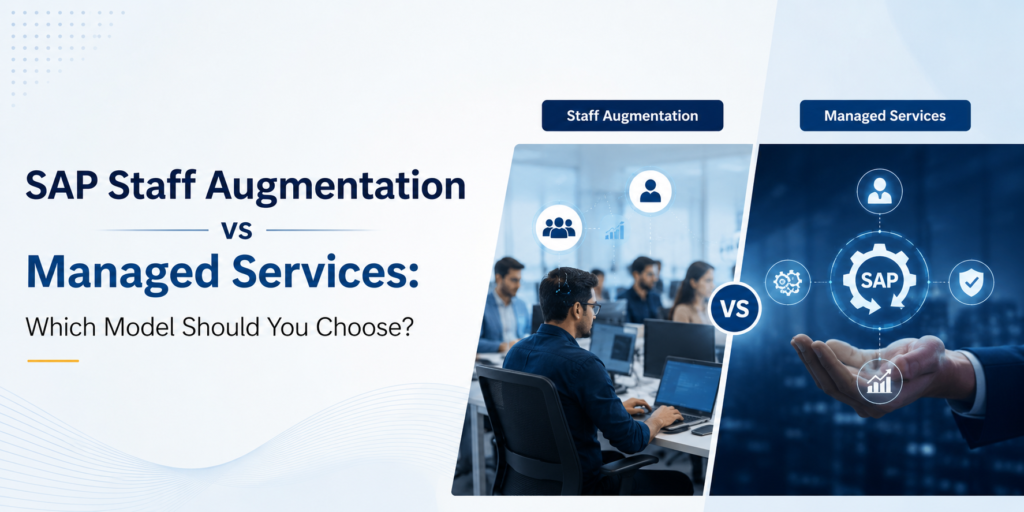
Going live with SAP is a major milestone, but it is not the end of the ERP journey.
Once the system enters production, businesses need to manage incidents, integrations, users, performance, security, updates, and ongoing process improvements. Internal IT teams can quickly become overloaded when they are expected to handle all of these responsibilities alongside their regular business priorities.
This is why enterprises turn to SAP managed services after go-live.
Instead of treating SAP support as a reactive helpdesk function, managed services provide a structured approach to keeping the SAP environment stable, supported, and continuously improved.
What Are SAP Managed Services?
SAP managed services are ongoing services provided by an SAP partner to operate, support, monitor, and optimize defined areas of an organization’s SAP environment.
Depending on the agreement, services can cover:
- SAP application support
- SAP Basis administration
- System monitoring
- Incident management
- Integration support
- SAP security
- Performance optimization
- Release management
- Application enhancements
- User support
- SAP cloud operations
The exact scope depends on the organization’s SAP landscape and service requirements.
Why Does SAP Support Matter After Go-Live?
The post-go-live environment is different from the implementation phase.
During implementation, the focus is on building and deploying the solution.
After go-live, the focus shifts to keeping business operations running.
A production SAP environment may experience:
- User issues
- Integration failures
- Performance problems
- Data inconsistencies
- Configuration requests
- Security requirements
- New business requirements
- System updates
- Reporting changes
Even a well-tested SAP implementation will require ongoing attention.
7 Powerful Reasons Enterprises Choose SAP Managed Services
1. Faster Issue Resolution
When SAP becomes critical to daily operations, prolonged system issues can affect finance, procurement, sales, manufacturing, supply chain, and other business functions.
A managed services team provides a defined support structure for identifying, prioritizing, and resolving incidents.
Instead of searching for specialist resources whenever an issue occurs, enterprises have access to an established support team.
2. Access to Specialized SAP Expertise
Maintaining expertise across every SAP technology internally can be difficult.
An enterprise may require specialists across:
- SAP S/4HANA
- SAP Fiori
- SAP ABAP
- SAP Basis
- SAP integrations
- SAP security
- SAP analytics
- SAP BTP
With SAP managed services, businesses can access specialized skills without building a large internal team for every technology area.
This is particularly useful when an organization has a lean SAP team but operates a complex ERP environment.
3. Reduced Pressure on Internal IT Teams
Internal IT teams often have competing priorities.
They may need to work on cybersecurity, infrastructure, applications, digital transformation, business systems, and strategic projects at the same time.
Outsourcing defined SAP operations allows internal teams to focus on higher-value initiatives while the managed services provider handles agreed SAP responsibilities.
4. Proactive SAP Monitoring
Traditional support can be reactive.
An issue occurs, a user reports it, and the support team investigates.
Managed services can take a more proactive approach by monitoring systems and identifying potential problems before they significantly affect users.
Monitoring can cover:
- System availability
- Performance
- Interfaces
- Jobs
- Infrastructure
- Application health
- Integration failures
This helps shift SAP support from incident response to operational prevention.
5. Predictable SAP Support Costs
Managing SAP internally can involve multiple costs, including salaries, specialist contractors, training, tools, monitoring, and after-hours support.
A managed services agreement consolidates defined services into an agreed commercial model.
This can make support costs easier to plan while giving enterprises access to a broader pool of SAP expertise.
However, organizations should compare the complete cost of internal operations with the scope and service levels offered by a provider rather than comparing hourly rates alone.
6. Continuous SAP Optimization
Go-live should not mean the SAP environment remains unchanged.
Business requirements evolve.
Companies add locations, products, processes, integrations, users, and reporting requirements.
A managed services partner can support continuous improvements such as:
- Process optimization
- Performance improvements
- Automation
- Minor enhancements
- Reporting improvements
- Integration changes
- User experience improvements
This helps organizations get more value from their SAP investment over time.
7. Better Business Continuity
SAP often supports business-critical processes.
If the ERP system experiences an extended issue, the impact can extend beyond IT.
Finance may be unable to process transactions. Procurement may face delays. Manufacturing may lose visibility. Supply chain operations may be disrupted.
A structured managed services model provides defined support processes, escalation paths, monitoring, and specialist access to help maintain operational continuity.
SAP Managed Services vs Internal SAP Support
| Area | Internal SAP Support | SAP Managed Services |
|---|---|---|
| SAP expertise | Internal team | External specialist team |
| Resource scaling | Hiring or contractors | Provider-managed capacity |
| Monitoring | Internal responsibility | Can be provider-managed |
| Support coverage | Depends on team size | Defined service coverage |
| SLA management | Internal | Contractual SLAs |
| Specialist access | Limited to available staff | Broader skill pool |
| Cost model | Staffing and operational costs | Agreed service model |
| Continuous improvement | Internal roadmap | Included based on scope |
Neither model is automatically better.
For some enterprises, internal support remains the preferred approach. For others, managed services provide better scalability and access to specialist capabilities.
What Services Can an SAP Managed Services Provider Deliver?
SAP Application Management
Application teams handle incidents, service requests, configuration issues, and functional support across SAP modules.
SAP Basis Services
Basis specialists can support system administration, monitoring, performance, transport management, and technical operations.
Integration Management
Providers can monitor and support integrations between SAP and systems such as CRM, banking, warehouse management, e-commerce, logistics, and third-party applications.
SAP Security Support
Security services can cover user access, roles, authorization issues, and security-related operational requirements.
Performance Management
Monitoring helps identify slow transactions, system bottlenecks, failed jobs, and other performance concerns.
Enhancement Support
Businesses can use managed services teams for smaller enhancements and continuous improvements without launching a separate project for every requirement.
When Should an Enterprise Consider SAP Managed Services?
SAP managed services may make sense when:
- Your internal SAP team is overloaded
- SAP supports mission-critical business processes
- You need specialist SAP skills
- You require extended support coverage
- Your SAP landscape is becoming more complex
- You want proactive system monitoring
- You need predictable support processes
- You want to reduce operational workload
The decision should be based on the organization’s SAP operating model rather than simply the number of SAP users.
How to Choose an SAP Managed Services Partner
Before signing a managed services agreement, evaluate the provider across several areas.
SAP Expertise
Check experience with your SAP products, modules, integrations, and industry requirements.
SLA Structure
Understand response times, resolution targets, escalation procedures, and service availability.
Support Coverage
Clarify whether support is available during business hours, extended hours, or 24/7.
Monitoring
Ask what the provider monitors and how proactively it identifies potential issues.
Security
Review access controls, security processes, compliance practices, and data protection responsibilities.
Continuous Improvement
Determine whether the provider only resolves incidents or also helps improve system performance and business processes.
Reporting
A good service model should provide regular reporting around incidents, SLAs, recurring problems, system health, and improvement activities.
What Should Be Included in an SAP Managed Services Agreement?
A strong agreement should clearly define:
- Service scope
- Supported SAP systems
- Modules covered
- Support hours
- SLAs
- Incident priorities
- Escalation process
- Monitoring responsibilities
- Security responsibilities
- Change management
- Reporting
- Service review meetings
- Continuous improvement
- Pricing and additional service charges
Clear scope prevents confusion after the contract begins.
SAP Managed Services After Go-Live: The Bigger Picture
The objective of post-go-live support should not be limited to fixing problems.
A mature SAP operating model should continuously answer:
Is the system stable?
Are users productive?
Are business processes efficient?
Are integrations performing correctly?
Where can automation reduce manual work?
What should be improved next?
This is where managed services can evolve from traditional application support into a long-term SAP optimization function.
Final Takeaway
Enterprises choose SAP managed services after go-live because operating SAP successfully requires more than fixing occasional incidents.
Managed services can provide specialist expertise, proactive monitoring, structured support, predictable service processes, and continuous optimization.
The right model depends on your internal capabilities and business requirements.
If your internal team has strong SAP expertise and sufficient capacity, a largely internal support model may work well.
If your organization needs specialist skills, extended support, proactive monitoring, or reduced operational responsibility, SAP managed services can provide a scalable alternative.
The goal is simple: keep SAP stable today while continuously improving what it delivers tomorrow.