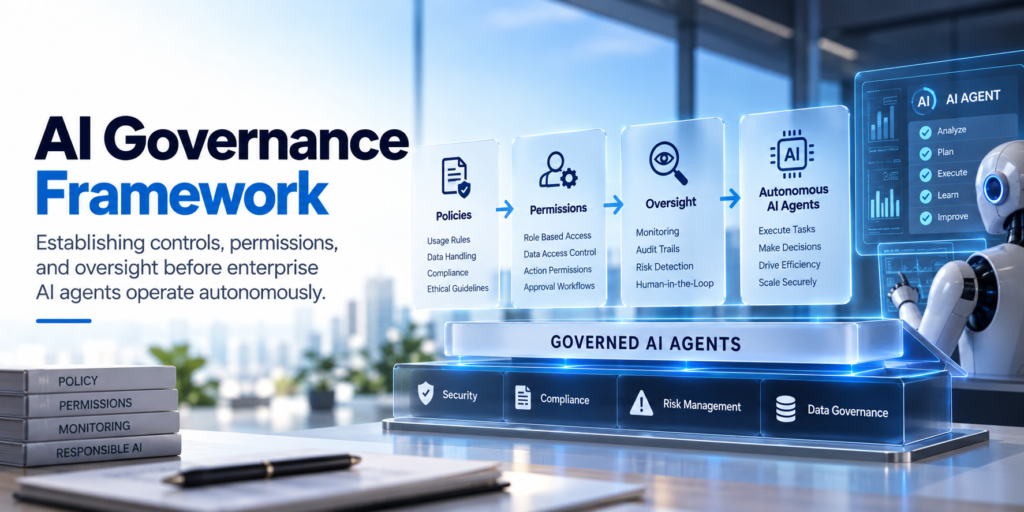
Mapping GRC to AI Agent Controls: Building a Governance Framework for Enterprise AI
AI agents are moving beyond answering questions. They can access enterprise data, interact with applications, make recommendations, and in some cases execute business actions.
That creates a new governance challenge.
Traditional GRC (Governance, Risk, and Compliance) frameworks were designed around people, applications, processes, and transactions. AI agents introduce another operational layer that can make decisions and take actions dynamically.
The question for enterprises is no longer simply:
“Is this AI agent useful?”
It is:
“Can we control what this AI agent can see, decide, and do?”
Mapping existing GRC principles to AI agent controls provides a practical way to answer that question.
What Is GRC for AI Agents?
GRC brings together three core areas:
- Governance: Who defines and oversees AI usage?
- Risk: What could go wrong?
- Compliance: Are AI activities aligned with applicable rules and policies?
For AI agents, these principles need to extend into the agent’s entire lifecycle.
An AI agent may need controls covering:
Identity → Access → Data → Actions → Approvals → Monitoring → Audit
This creates a governance model that connects traditional enterprise controls with the behavior of autonomous or semi-autonomous AI systems.
Why Traditional GRC Controls Are Not Enough
Traditional enterprise applications generally execute predefined workflows.
An AI agent can behave differently depending on:
- User instructions
- Available data
- Context
- Tools
- Model responses
- Business rules
- Previous actions
- Connected applications
This introduces new questions.
Can the agent access sensitive financial information?
Can it modify an SAP transaction?
Can it approve a purchase order?
Can it create a vendor?
Can it bypass an approval workflow?
Can administrators determine why an action occurred?
These are not purely AI questions. They are governance and control questions.
Mapping GRC to AI Agent Controls
A useful framework is to map traditional GRC principles directly to agent-level controls.
| GRC Area | AI Agent Control |
|---|---|
| Identity Management | Agent identity and authentication |
| Access Control | Permission boundaries |
| Segregation of Duties | Separation between agent capabilities |
| Risk Management | Agent risk classification |
| Compliance | Policy enforcement |
| Audit | Agent activity logs |
| Monitoring | Continuous behavior monitoring |
| Change Management | Version and configuration controls |
| Incident Management | Agent action escalation and response |
This mapping helps organizations extend existing governance rather than creating an entirely separate framework for AI.
1. Identity: Every Agent Needs an Identity
An AI agent should not operate as an anonymous automation process.
Enterprises need to know:
- Which agent is operating?
- Who deployed it?
- Who owns it?
- Which environment is it running in?
- Which user or business process initiated the action?
A distinct identity creates accountability.
For example, an enterprise may have separate agents for procurement, finance, customer service, and supply chain operations.
Each should have an identifiable owner and defined purpose.
2. Access Control: What Can the Agent Access?
Not every agent should have access to every enterprise system.
Access should follow the principle of least privilege.
A procurement agent may need access to:
- Purchase requisitions
- Supplier information
- Purchase orders
- Inventory data
It may not need access to payroll, employee records, or unrelated financial information.
AI agent controls should therefore define:
What data can the agent read?
What systems can it access?
What actions can it perform?
What actions are prohibited?
3. Segregation of Duties for AI Agents
Segregation of duties is a familiar GRC principle.
The same principle becomes important when AI agents can perform multiple business activities.
Consider a procurement workflow.
An agent that can:
- Create a supplier
- Create a purchase order
- Approve the purchase order
could create a significant control risk.
Instead, organizations can separate these responsibilities across different agents, users, or approval stages.
The goal is simple:
An agent should not have more authority than its business purpose requires.
4. Define Agent Risk Levels
Not every AI agent creates the same level of risk.
A useful classification could be:
Low Risk
Agents that summarize information or answer internal questions.
Medium Risk
Agents that prepare recommendations, documents, or transactions for human approval.
High Risk
Agents that can directly execute financial, operational, or sensitive actions.
The higher the risk, the stronger the required controls should become.
High-risk agents may require:
- Human approval
- Strong authentication
- Restricted permissions
- Enhanced monitoring
- Detailed audit trails
- Periodic reviews
5. Human-in-the-Loop Controls
Autonomy should not automatically mean unrestricted autonomy.
For sensitive processes, organizations can establish approval checkpoints.
For example:
Agent identifies transaction → validates rules → prepares action → human approval → system execution
This approach allows AI to reduce manual effort while maintaining accountability for high-impact decisions.
The level of human involvement should depend on the risk of the action.
6. Continuous Monitoring
Traditional application controls often focus on whether a transaction meets predefined rules.
AI agents require broader monitoring.
Organizations should track:
- Agent activity
- Tool usage
- Data access
- Actions performed
- Failed actions
- Policy violations
- Unusual behavior
- Escalations
- Human overrides
This creates visibility into not only what the agent decided, but also what the agent actually did.
7. Auditability: Every Important Action Should Leave a Trail
When an AI agent performs an enterprise action, organizations should be able to reconstruct the event.
A useful audit record can capture:
Agent → User → Request → Data/Context → Decision → Action → Result
This becomes particularly important for financial transactions, procurement, compliance-sensitive workflows, and other high-impact processes.
Without sufficient auditability, investigating an unexpected AI action becomes significantly more difficult.
8. Policy Enforcement Should Happen Before Execution
AI governance should not depend entirely on reviewing actions after they happen.
Controls should be placed directly in the execution path.
For example:
AI Agent → Policy Check → Authorization → Business Rule Validation → Execution
If an action violates a defined policy, the system can block it or route it for human approval.
This moves governance from after-the-fact monitoring toward preventive control.
9. Agent Lifecycle Management
AI agents should be governed throughout their lifecycle.
That includes:
Design → Testing → Approval → Deployment → Monitoring → Modification → Retirement
Organizations should maintain records for:
- Agent owner
- Business purpose
- Version
- Connected systems
- Permissions
- Risk classification
- Approval status
- Performance
- Incidents
An agent should not remain permanently deployed simply because it was once approved.
Building an AI Agent Control Framework
A practical enterprise framework can be built around six layers:
1. Govern
Define policies, ownership, accountability, and risk classifications.
2. Identify
Give every agent a unique identity and establish its business purpose.
3. Control
Define permissions, policies, segregation of duties, and approval requirements.
4. Monitor
Track agent behavior, data access, actions, exceptions, and policy violations.
5. Audit
Maintain evidence of important decisions and actions.
6. Improve
Review performance, incidents, permissions, and controls continuously.
This creates a governance loop rather than a one-time compliance exercise.
From GRC to Agent Governance
The transition can be visualized simply:
Traditional GRC
Users → Applications → Transactions → Controls → Audit
AI-Enabled Enterprise
Users + AI Agents → Applications → Data + Decisions + Actions → Agent Controls → Monitoring → Audit
The control layer becomes more dynamic because AI agents can interact with multiple systems and perform multi-step workflows.
What Enterprises Should Do Now
Organizations preparing for enterprise AI should start by identifying where agents could interact with sensitive business processes.
Ask:
- Which AI agents are currently deployed?
- What systems can they access?
- What data can they read?
- What actions can they perform?
- Who owns each agent?
- Which actions require human approval?
- Are agent activities logged?
- Can permissions be reviewed and revoked?
- How are policy violations detected?
- Can the organization reconstruct an agent’s important actions?
These questions provide a starting point for mapping existing GRC controls to the AI environment.
Final Takeaway
AI agents can create significant business value, but greater autonomy requires greater control.
The answer is not to treat AI governance as a completely separate discipline.
Instead, enterprises can extend familiar GRC principles into the AI layer by applying identity, access control, segregation of duties, risk classification, policy enforcement, monitoring, auditability, and lifecycle management to AI agents.
The future enterprise will not simply ask whether an AI agent can perform a task.
It will ask:
Can the agent perform the right task, with the right access, under the right policy, with the right level of oversight?
That is where GRC becomes AI agent control.