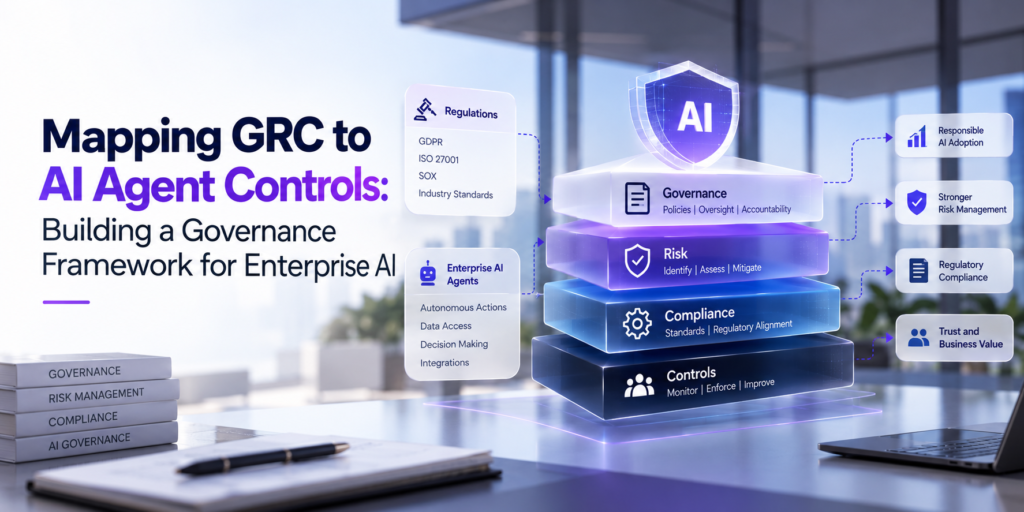
Governance Before Autonomy: Why Enterprise AI Needs Controls Before It Scales
AI Governance agents are moving beyond answering questions. They can retrieve enterprise data, interact with business applications, coordinate workflows, and execute actions with limited human intervention.
For enterprises, this creates an important question: How much autonomy should an AI agent have before the organization can reliably govern its actions?
The temptation is to focus on what AI agents can automate. But in business-critical environments, capability alone is not enough. Organizations also need clear permissions, accountability, risk controls, and visibility into every important action.
That is why governance must come before autonomy.
What Does Governance Before Autonomy Mean?
Governance before autonomy means establishing the rules, controls, and accountability structures an AI agent must follow before allowing it to operate independently.
Before an agent can execute a business action, an organization should understand:
- What the agent is designed to do
- Which systems and data it can access
- Which actions it is permitted to perform
- When human approval is required
- How its activities are monitored
- Who is accountable when something goes wrong
Without these controls, increasing autonomy can also increase operational, security, and compliance risks.
The objective is not to prevent AI adoption. It is to create the conditions for safe, scalable adoption.
Why AI Autonomy Without Governance Is Risky
Traditional enterprise software generally follows predefined workflows and permissions. AI agents introduce more dynamic behavior because their actions can depend on instructions, context, data, and connected tools.
Consider an AI agent supporting procurement. It might identify a supplier issue, review purchase information, recommend an alternative, and prepare a purchase order.
But what happens if it selects an unapproved supplier? What if it accesses information outside its assigned responsibilities? What if it executes a transaction without the required approval?
These are governance problems, not simply model-performance problems.
Organizations need controls that define what an agent can do, regardless of what it is capable of doing.
1. Define the Agent’s Identity and Ownership
Every enterprise AI agent should have a clearly defined purpose and accountable owner.
Organizations should document:
- Agent name and business function
- Business owner and technical owner
- Connected applications
- Approved use cases
- Risk classification
- Deployment environment
- Approval status
This creates accountability and helps prevent unmanaged agents from operating across business systems.
2. Establish Access Controls Before Deployment
An AI agent should receive only the permissions required to perform its assigned tasks.
For example, a finance assistant may need read access to financial reports but should not automatically receive permission to modify payment details or release payments.
Access controls should define which data an agent can read, which systems it can access, and which actions it can execute.
The principle is simple: an agent’s permissions should match its approved responsibilities, not its maximum technical capabilities.
3. Classify Actions by Risk
Not every AI action requires the same level of control.
A practical framework can separate actions into three categories:
Risk level
Example
Recommended control
Low
Summarizing reports
Automated execution with monitoring
Medium
Preparing purchase orders
Validation and approval where required
High
Releasing payments or changing critical records
Strong authorization and human approval
The appropriate controls depend on business impact, regulatory requirements, and the consequences of an incorrect action.
As the potential impact increases, so should the level of oversight.
4. Enforce Policies Before Actions Execute
Governance should not depend entirely on reviewing agent activity after an action has occurred.
Controls should operate within the execution process.
A governed workflow might look like this:
AI agent proposes an action → Policy validation → Permission check → Approval if required → Execution → Audit log
If an action violates a policy, the system should block it or route it for appropriate review.
This helps ensure that an agent cannot bypass established business controls simply because it can generate a valid-looking response.
5. Keep Human Oversight Where It Matters
Autonomy does not mean removing people from every decision.
Human approval remains important for actions involving financial commitments, sensitive information, regulatory obligations, or significant operational impact.
Organizations should determine which actions can run automatically and which require human intervention.
For example, an agent may automatically identify an invoice discrepancy but require approval before releasing a payment.
This allows enterprises to benefit from automation while preserving accountability for high-impact decisions.
6. Monitor Agents Continuously
Approval at deployment is only the beginning of governance.
AI agents may encounter new data, changing business conditions, updated permissions, or unexpected system responses. Their activity must therefore remain visible throughout their operational lifecycle.
Monitoring should cover:
- Data access
- Tool usage
- Actions performed
- Policy violations
- Failed executions
- Unusual activity
- Human overrides
- Changes to agent permissions
Organizations should also establish procedures to suspend an agent, revoke access, and investigate incidents when necessary.
7. Build Auditability Into Every Important Action
When an agent performs a significant business action, the organization should be able to reconstruct what happened.
A useful audit trail records the agent identity, initiating request, relevant context, authorization checks, approvals, executed action, and outcome.
This is especially important in finance, procurement, HR, and other sensitive enterprise workflows.
Auditability supports investigations, accountability, compliance reviews, and continuous improvement.
From Governed Agents to Greater Autonomy
Governance should evolve alongside an agent’s capabilities.
A sensible maturity model can help organizations increase autonomy gradually.
Stage 1: Observe
The agent analyzes information and provides recommendations without executing actions.
Stage 2: Assist
The agent prepares work for human review and approval.
Stage 3: Execute With Controls
The agent performs approved actions within defined permissions and policy boundaries.
Stage 4: Bounded Autonomy
The agent manages eligible workflows independently, with monitoring, escalation rules, and clear limits.
Stage 5: Continuous Optimization
The organization reviews performance, incidents, permissions, and business outcomes before expanding the agent’s responsibilities.
Progression should depend on demonstrated reliability and effective controls, not simply the availability of more advanced AI technology.
What This Means for SAP and Enterprise AI
For organizations using SAP and other enterprise platforms, AI agents may eventually interact with procurement, finance, supply chain, HR, and operational workflows.
These environments already depend on access controls, approval hierarchies, segregation of duties, and audit requirements.
AI governance must work alongside these existing controls.
For example, an agent that prepares a supplier payment should not bypass the organization’s payment approval process. An agent that modifies master data should operate within defined permissions and leave an auditable record.
Enterprises should therefore evaluate how agent governance integrates with their existing identity management, enterprise security, business rules, and governance, risk, and compliance (GRC) frameworks.
How to Start Building an AI Governance Framework
Organizations can begin with a focused approach:
- Inventory the AI agents currently deployed or being tested.
- Assign a business owner to each agent.
- Document data access and permitted actions.
- Classify agents according to business risk.
- Define approval requirements and prohibited actions.
- Implement monitoring, logging, and incident response.
- Test controls before expanding autonomy.
- Review permissions and performance regularly.
This approach makes governance a practical part of AI implementation rather than a separate exercise performed after deployment.
Final Takeaway
Enterprise AI will continue to move toward greater autonomy. But autonomy without clear boundaries can create risks that outweigh its benefits.
Organizations need to establish identity, permissions, policies, approval mechanisms, monitoring, and accountability before allowing agents to execute increasingly important business actions.
Governance is not a barrier to autonomy. It is what makes autonomy sustainable.
The enterprises that scale AI successfully will not necessarily be those that automate the fastest. They will be those that know which decisions to delegate, which actions to restrict, and how to remain in control as their AI capabilities grow.