Growth exposes weaknesses in business systems.
A company may start with accounting software, spreadsheets, separate CRM tools, and disconnected operational applications. As revenue, locations, products, and customers increase, those systems can create duplicate data, manual work, limited reporting, and difficult integrations.
GROW with SAP is designed for businesses that have reached this stage and need a more scalable ERP foundation.
SAP positions GROW with SAP as its entry point to cloud ERP, built around SAP S/4HANA Cloud Public Edition. It combines cloud ERP capabilities with preconfigured business processes, AI, automation, and services designed to help growing businesses adopt ERP faster.
But the important question is not whether GROW with SAP has features.
The question is:
Does it fit the way your business needs to grow?
What Is GROW with SAP?
GROW with SAP is a cloud ERP offering designed primarily for growing businesses and organizations moving to SAP for the first time.
At its core is SAP S/4HANA Cloud Public Edition, a SaaS ERP platform that provides standardized business processes and continuous updates. SAP also combines the ERP platform with adoption resources, services, and additional cloud capabilities.
The approach is different from building a heavily customized ERP environment from the beginning.
Instead, businesses can start with SAP’s predefined processes and configure the platform around their requirements.
This makes GROW with SAP particularly relevant when speed, standardization, scalability, and predictable operations are priorities.
Who Is GROW with SAP For?
GROW with SAP is worth evaluating if your business:
- Has outgrown entry-level accounting or ERP software
- Is expanding into new markets
- Needs finance and operations on one platform
- Wants cloud ERP without managing infrastructure
- Needs standardized business processes
- Wants embedded AI and automation
- Needs an ERP platform that can scale with growth
SAP specifically describes GROW with SAP as a fit for companies new to SAP, businesses outgrowing entry-level systems, and organizations looking to unify areas such as finance, supply chain, and HR.
Why Businesses Consider GROW with SAP
1. Faster ERP Adoption
Traditional ERP projects can become lengthy when every process is designed from scratch.
GROW with SAP takes a different approach using preconfigured processes and SAP best practices.
This can reduce unnecessary design work and help organizations move toward deployment faster. SAP has described the offering as supporting rapid adoption and, in some scenarios, go-live within weeks. Actual timelines depend on scope, data, integrations, and implementation complexity.
2. Standardized Processes
Growth often creates process inconsistency.
One location may manage purchasing differently from another. Finance teams may use different reporting methods. Sales and inventory data may sit in separate systems.
GROW with SAP provides standardized processes based on SAP’s industry experience.
The advantage is not simply having an ERP system.
It is having a common operating model that can support expansion.
3. Cloud ERP Without Infrastructure Management
With SAP S/4HANA Cloud Public Edition, SAP manages many of the underlying technical responsibilities, including installation and upgrades.
This can reduce the infrastructure burden on internal IT teams.
Instead of maintaining ERP servers, teams can focus more on:
- Business applications
- Data
- Integrations
- Process improvement
- Analytics
- Business growth
4. Built-In AI and Automation
GROW with SAP is not positioned simply as a cloud replacement for traditional ERP.
SAP highlights embedded AI, automation, and insights as part of its current GROW offering, including Joule capabilities within business processes.
For growing businesses, this can help automate repetitive work and provide users with more accessible operational information.
The practical value depends on which capabilities are included in the selected offering and how the organization implements them.
5. Easier Scaling
Growth introduces new requirements.
You may add:
- New subsidiaries
- New warehouses
- New products
- New currencies
- New customers
- New suppliers
- New markets
An ERP platform needs to accommodate that growth without forcing the company to replace its core system every few years.
SAP positions SAP S/4HANA Cloud Public Edition as a platform that can support businesses as they expand, including organizations operating internationally.
GROW with SAP vs Traditional ERP
| Area | GROW with SAP | Traditional ERP Approach |
|---|---|---|
| Deployment | Cloud | On-premises or private infrastructure |
| Processes | Preconfigured best practices | Often heavily customized |
| Infrastructure | SAP-managed cloud environment | Customer or provider managed |
| Updates | Continuous cloud updates | Planned upgrade projects |
| Implementation | Standardized approach | Often highly project-specific |
| Scalability | Designed for cloud growth | Depends on architecture |
| IT workload | Lower infrastructure responsibility | Higher infrastructure responsibility |
| Innovation | Regular cloud capabilities | Dependent on upgrade cycle |
The biggest difference is the operating philosophy.
GROW with SAP favors standardization and continuous cloud innovation.
Traditional ERP approaches often prioritize greater control and customization.
What About Customization?
This is one area business leaders should evaluate carefully.
GROW with SAP is designed around standardized cloud ERP processes. SAP’s current positioning emphasizes preconfigured processes and keeping the ERP environment easier to maintain.
If your business has highly specialized processes that require extensive modifications to the ERP core, GROW with SAP may require more careful assessment.
The better question is:
Can the business adopt the standard process, or does the ERP need to be changed to match the business?
For many growing companies, standardizing non-differentiating processes can be an advantage.
GROW with SAP vs RISE with SAP
These offerings should not be treated as interchangeable.
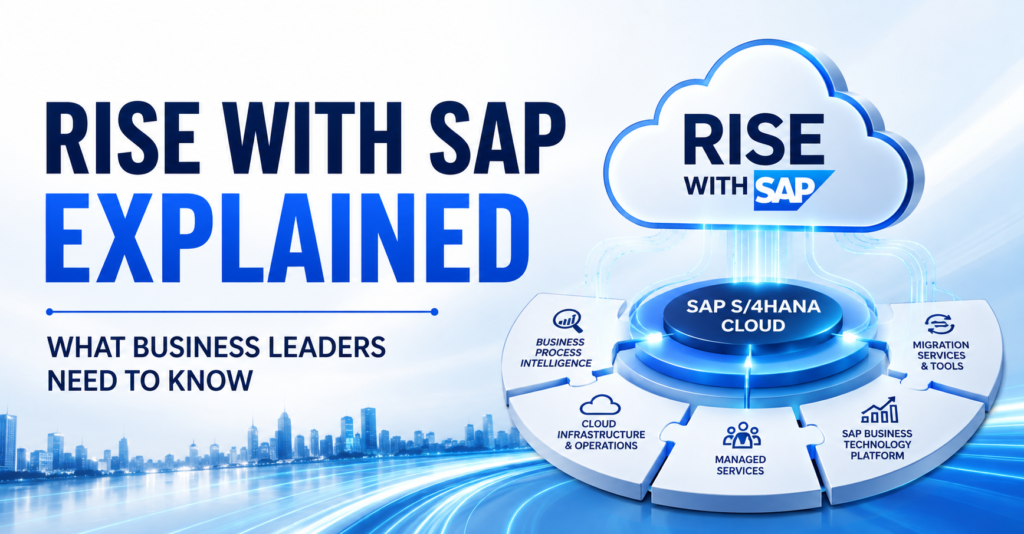
SAP’s learning materials identify GROW with SAP with SAP S/4HANA Cloud Public Edition and RISE with SAP with SAP S/4HANA Cloud Private Edition in their respective commercial bundles.
A simplified view:
| GROW with SAP | RISE with SAP |
|---|---|
| Public cloud ERP | Private cloud ERP |
| Strong focus on standard processes | Greater flexibility for complex environments |
| Well suited to cloud-first adoption | Often suited to more complex transformation scenarios |
| SAP S/4HANA Cloud Public Edition | SAP S/4HANA Cloud Private Edition |
The right option depends on your current ERP landscape, customization requirements, business processes, and transformation goals.
When GROW with SAP May Be the Right Choice
GROW with SAP deserves serious consideration when:
You Are New to SAP
If your organization is moving from a smaller ERP platform to enterprise-grade ERP, GROW can provide a structured entry point.
Your Processes Can Be Standardized
If finance, procurement, sales, inventory, and other processes can follow established best practices, the public cloud model can be attractive.
You Want Cloud First
If avoiding infrastructure management is a priority, SaaS ERP can reduce the technical burden.
You Are Growing Internationally
If your business needs stronger financial, operational, and localization capabilities as it enters new markets, a scalable ERP foundation becomes increasingly important.
You Want Continuous Innovation
If your strategy is to consume regular cloud updates rather than manage large upgrade projects, GROW with SAP aligns better with that model.
When Should You Look Beyond GROW with SAP?
GROW with SAP is not automatically the right answer for every company.
Consider a deeper evaluation if you have:
- Extensive legacy SAP customizations
- Highly specialized industry processes
- Complex existing integrations
- Strict architectural requirements
- Significant requirements for ERP-core modifications
- A large existing SAP landscape
In these cases, comparing GROW with SAP against other SAP cloud deployment options can help determine the appropriate architecture.
What Should You Evaluate Before Buying?
Before selecting GROW with SAP, evaluate five areas.
1. Business Processes
Identify which processes are unique to your business and which can adopt standard SAP processes.
2. Data
Review master data quality, migration requirements, historical records, and data ownership.
3. Integrations
Map your CRM, e-commerce, banking, warehouse, logistics, manufacturing, payroll, and other systems.
4. User Adoption
ERP success depends on employees actually using the new processes correctly.
5. Total Cost
Look beyond the software subscription.
Consider implementation, data migration, integrations, training, change management, support, and future expansion.
Final Verdict: Is GROW with SAP Right for Your Business?
GROW with SAP can be a strong ERP strategy for a growing business when speed, standardized processes, cloud delivery, and scalability matter more than extensive ERP customization.
It is particularly relevant for organizations moving beyond entry-level systems and looking for a modern cloud ERP foundation.
However, the right decision should come from a business and process assessment, not simply the size of the company.
If your business can adopt standard processes and wants to scale without building a complex IT infrastructure around ERP, GROW with SAP is worth evaluating.
If your operations depend heavily on specialized processes and extensive customizations, another SAP deployment approach may be a better fit.