What Is Agentic AI for SAP S/4HANA? A Practical Guide for GCC Enterprises
Enterprise AI is moving beyond chatbots and automated reports. AI agents can now be designed to interpret business objectives, gather information from enterprise systems, coordinate multiple steps, and execute defined tasks within approved boundaries.
For enterprises across the UAE and Saudi Arabia, this creates new opportunities to modernize finance, procurement, supply chain, and other SAP-driven business processes.
Agentic AI for SAP S/4HANA brings together AI reasoning, enterprise data, and business workflows to help organizations move from simply analyzing information to taking controlled action.
But introducing AI agents into an enterprise environment requires more than connecting a language model to SAP. Businesses must also consider access permissions, data protection, business rules, auditability, and governance.
This guide explains how agentic AI works with SAP S/4HANA, where GCC enterprises can apply it, and why governance should be part of the architecture from the beginning.
What Is Agentic AI for SAP S/4HANA?
Agentic AI refers to AI systems designed to pursue a defined goal by planning tasks, using available tools, evaluating information, and taking actions across connected systems.
Traditional AI applications typically answer questions, generate content, or provide recommendations. AI agents can go further by coordinating multiple steps toward completing a business task.
For example, a traditional AI assistant might summarize overdue supplier invoices. An AI agent could be designed to identify overdue invoices, retrieve relevant purchase order information, investigate discrepancies, and prepare exceptions for review.
With the appropriate integrations and permissions, certain steps could be automated. Sensitive financial actions would still need to follow the organization’s authorization and approval requirements.
Within an SAP S/4HANA environment, agentic AI can work with business data and processes through supported interfaces, APIs, and integration services.
The objective is not to replace the ERP system. It is to help people and applications use enterprise information more effectively while keeping business operations controlled.
How Does Agentic AI Work With SAP S/4HANA?
An enterprise AI agent typically operates through several connected components.
1. Business Intent
The process begins with a defined business objective, such as investigating overdue invoices, identifying procurement exceptions, or analyzing supply chain disruptions.
2. Enterprise Context
The agent retrieves the information it is authorized to access. This may include SAP business data, transaction records, business rules, and relevant information from connected applications.
3. Reasoning and Planning
The agent determines which steps are needed to address the request. Depending on the use case, it may query data, compare records, calculate potential impacts, or identify exceptions.
4. Controlled Execution
The agent performs only the actions permitted by its configuration and access rights. Actions that require approval can be routed to the appropriate employee.
5. Monitoring and Audit
The organization tracks important actions, approvals, outcomes, and exceptions so that the workflow remains accountable.
SAP provides technologies for building and integrating AI agents through SAP Business Technology Platform, including Joule Studio and related AI services. The specific capabilities available depend on the SAP products, release, architecture, and licensing involved.
Why GCC Enterprises Are Exploring Agentic AI
Organizations in the Gulf Cooperation Council operate across industries such as energy, manufacturing, logistics, construction, retail, and financial services.
Many manage complex supply chains, multiple legal entities, regional operations, and large volumes of enterprise transactions.
For these businesses, agentic AI offers an opportunity to reduce repetitive coordination and help teams respond to operational issues more efficiently.
Across the UAE and Saudi Arabia, digital transformation initiatives also create a wider context for exploring AI-enabled enterprise operations. The UAE’s official AI Charter, for example, emphasizes responsible AI use, privacy, and data security.
The business case should still begin with a specific operational challenge rather than adopting AI simply because the technology is available.
5 Practical Use Cases for Agentic AI in SAP S/4HANA
1. Finance and Accounts Payable
Finance teams often spend considerable time investigating invoice discrepancies, checking payment status, and coordinating approvals.
An AI agent could help identify overdue invoices, compare invoice and purchase order information, flag mismatches, and prepare a prioritized exception list.
The potential benefit is less manual investigation and faster access to relevant information.
Payment execution, changes to sensitive financial records, and other high-impact actions should remain subject to defined authorization controls.
2. Procurement and Supplier Management
Procurement teams need visibility into purchase orders, supplier commitments, delivery status, and potential exceptions.
An agent could identify delayed orders, summarize supplier performance, flag missing information, and prepare recommendations for procurement teams.
For example, when a delivery is delayed, the agent could gather the relevant purchase order details and supplier history before presenting the issue to the responsible buyer.
This can help teams spend less time collecting information and more time resolving supplier problems.
3. Supply Chain and Inventory
Supply chain decisions often depend on information spread across planning, procurement, inventory, and logistics systems.
An agent could help identify unusual inventory movements, investigate stock discrepancies, and summarize potential supply risks.
For a manufacturing enterprise, this might involve identifying materials that are approaching a shortage and presenting relevant purchase orders, stock levels, and expected deliveries.
Any resulting changes to replenishment or production plans would depend on available integrations and the organization’s approval requirements.
4. Sales Order Management
Sales teams need to understand order status, delivery commitments, credit issues, and potential fulfilment delays.
An AI agent could retrieve relevant order information, identify blocked orders, summarize outstanding issues, and recommend next steps.
Instead of manually checking several transactions, a user could receive a consolidated view of the issue and its potential business impact.
5. Enterprise Reporting and Decision Support
Executives and department heads often need answers that involve several business functions.
An agent could gather authorized information from finance, procurement, inventory, and sales systems to prepare a consolidated operational summary.
For example, a regional operations leader could investigate why fulfilment performance has changed across business units.
The agent could identify relevant data points and highlight exceptions for further analysis. The reliability of the result would depend on data quality, integration coverage, and the controls governing access to the underlying information.
What Is the Difference Between SAP AI Assistants and AI Agents?
The terms are related, but they describe different capabilities.
| Capability | AI Assistant | AI Agent |
|---|---|---|
| Primary role | Answers questions and helps users | Works toward a defined objective |
| Information retrieval | Retrieves and summarizes information | Retrieves information needed for a task |
| Planning | Usually limited to the immediate request | Can plan multiple steps |
| Workflow execution | May initiate supported actions | Can coordinate permitted actions across a workflow |
| Human involvement | Typically user-directed | Depends on risk, permissions, and workflow design |
| Governance | Requires controlled access and responsible use | Requires controlled access, action boundaries, monitoring, and auditability |
The distinction is not absolute. Modern assistants can coordinate agents, and some agents may only perform a narrow analytical task.
SAP’s Joule ecosystem includes assistants and agents designed to support business processes. Enterprises should evaluate the capabilities of the specific solution rather than assume every AI feature provides autonomous execution.
Why AI Governance Matters for SAP AI Agents
Giving an AI agent access to SAP data or business processes creates a responsibility to control what it can see and do.
An agent that can retrieve information may present limited operational risk. An agent that can modify supplier records, create transactions, or initiate financial workflows requires stronger controls.
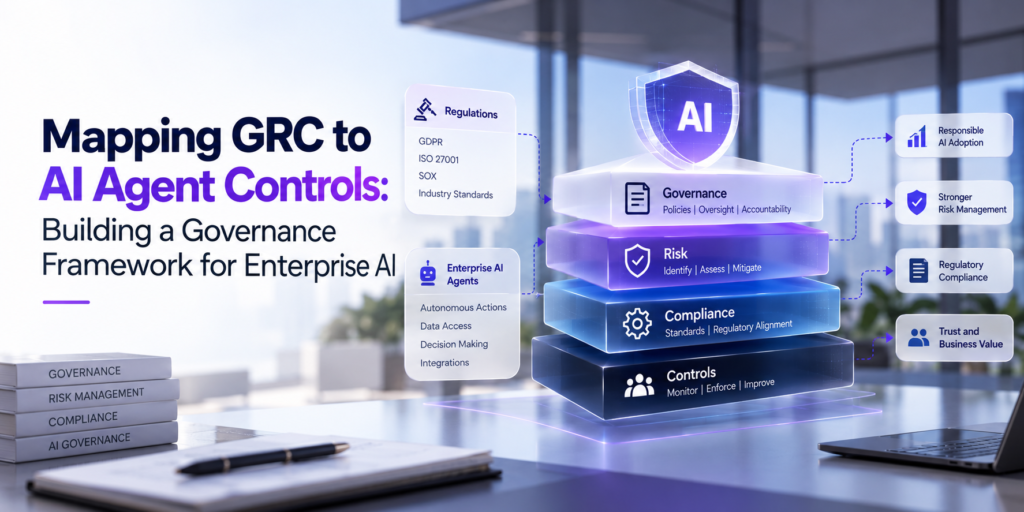
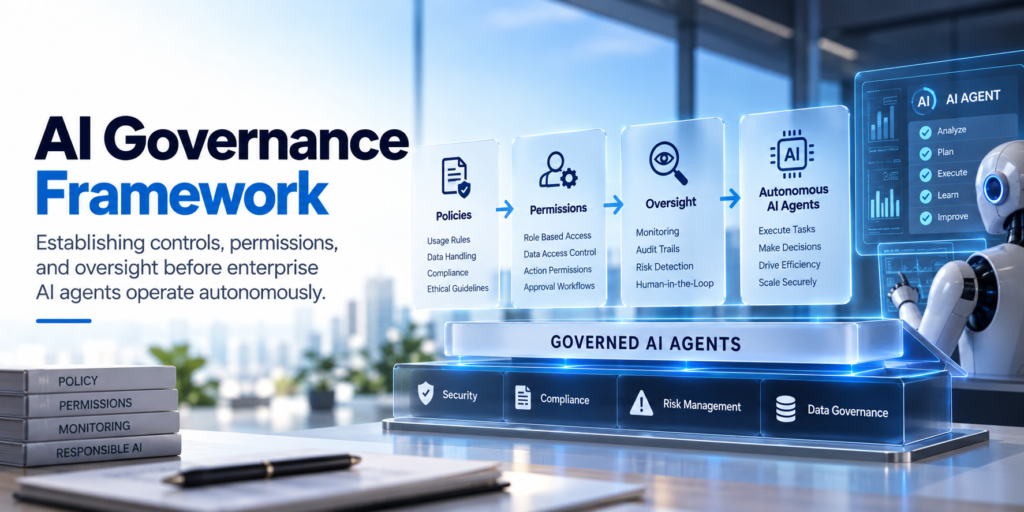
A practical governance framework should address five areas.
Identity and ownership: Every agent should have a defined purpose, accountable owner, and approved operating scope.
Access permissions: Agents should receive only the data and system permissions required for their tasks.
Business policies: Existing approval workflows, segregation of duties, and transaction rules should remain effective.
Human oversight: High-impact actions should be routed for approval when required by business policy or risk classification.
Monitoring and auditability: Important agent actions, decisions, approvals, and outcomes should be recorded and reviewable.
These controls should be designed before an agent is allowed to execute business-critical actions independently.
The Role of ANRILX in Enterprise AI Governance
As enterprises introduce agents across SAP and other applications, governance becomes more complex. Organizations need to understand which agents are operating, which systems they can access, and whether their actions comply with established policies.
ANRILX is positioned as an AI governance layer for enterprises running SAP, with a focus on governing AI agents and protecting enterprise data.
In an agentic SAP environment, an AI governance layer can be relevant to questions such as:
- Which agents are authorized to access specific enterprise resources?
- What actions are permitted for each agent?
- How should policies and approval requirements be enforced?
- How can organizations maintain oversight of agent activity?
- How should unauthorized or unexpected actions be handled?
The actual controls available depend on the product’s implemented capabilities and its integration with the customer’s SAP landscape. Enterprises should validate these capabilities against their security, compliance, and architecture requirements.
The key principle is that AI agents should operate within defined boundaries rather than receive unrestricted access to enterprise systems.
A Practical Roadmap for GCC Enterprises
Organizations planning agentic AI adoption can begin with a focused, phased approach.
Step 1: Identify a business problem. Choose a repetitive, measurable workflow such as invoice exception handling or purchase order investigation.
Step 2: Assess the SAP environment. Review the SAP S/4HANA release, available interfaces, connected applications, data quality, and integration requirements.
Step 3: Define the agent’s responsibilities. Specify what the agent should accomplish, which information it can access, and which actions it must not perform.
Step 4: Establish governance controls. Define access permissions, approval checkpoints, monitoring, audit requirements, and incident procedures.
Step 5: Test with limited scope. Validate the agent against realistic scenarios, including incorrect data, missing information, unauthorized requests, and exceptional transactions.
Step 6: Measure business outcomes. Evaluate processing time, exception resolution, accuracy, user adoption, and control effectiveness.
Step 7: Expand gradually. Extend the agent’s responsibilities only when its performance and governance controls have been validated.
For GCC organizations, the assessment should also consider applicable local regulatory obligations, data residency requirements, industry-specific controls, and internal information security policies.
Final Takeaway
Agentic AI for SAP S/4HANA offers a way to move beyond information retrieval toward coordinated, goal-oriented business workflows.
For enterprises in the UAE and Saudi Arabia, potential use cases span finance, procurement, supply chain, sales, and operational reporting. The value will depend on selecting the right processes, connecting reliable enterprise data, and defining clear limits around what AI agents can do.
The strongest starting point is not full autonomy. It is a well-defined business problem, a measurable outcome, and a governed implementation.
Ready to explore AI governance for your SAP environment?
Book an AnrilX demo to discuss how enterprise AI agent governance can fit into your SAP landscape and help establish a more controlled foundation for agentic AI adoption.